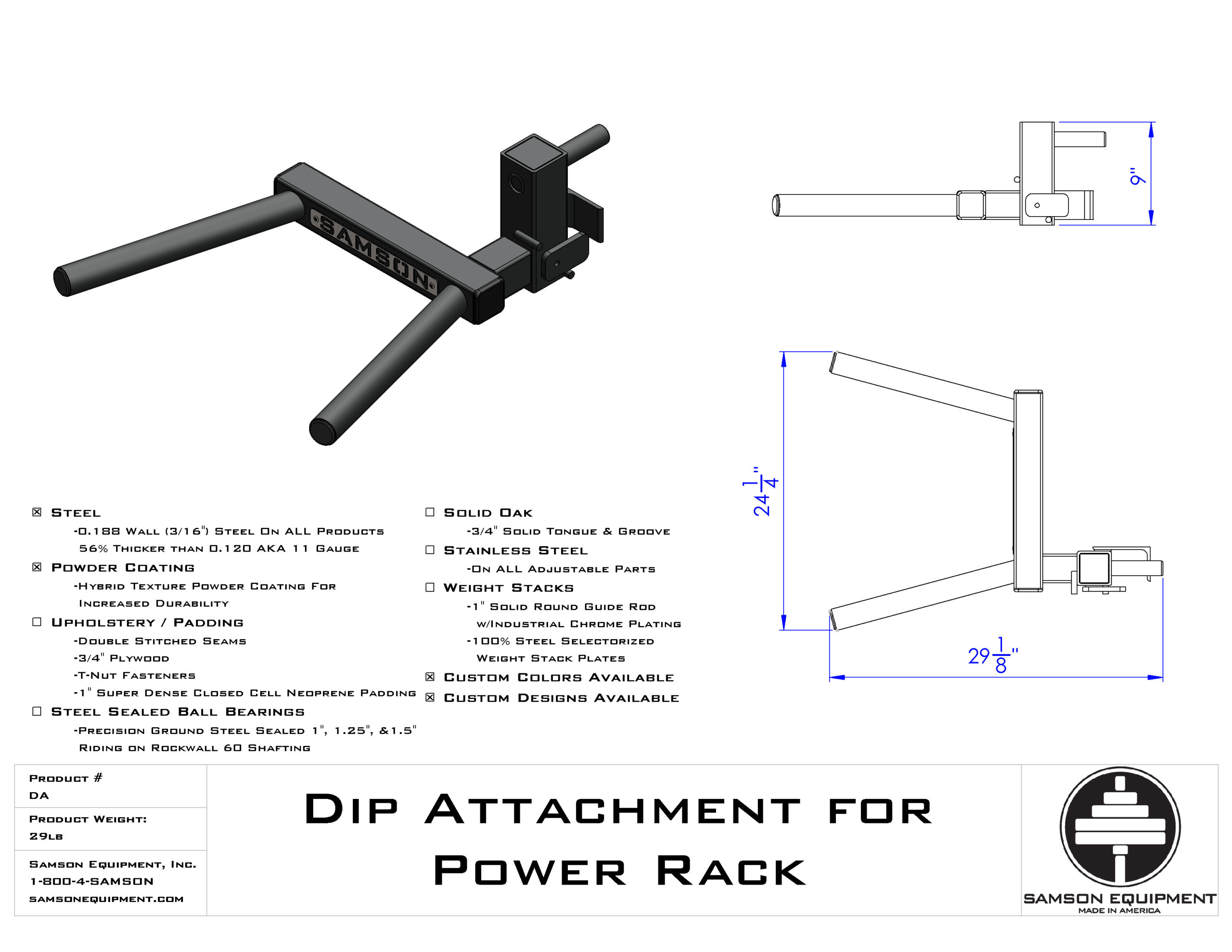
Product Specifications
| Dimensions | N/A |
|---|
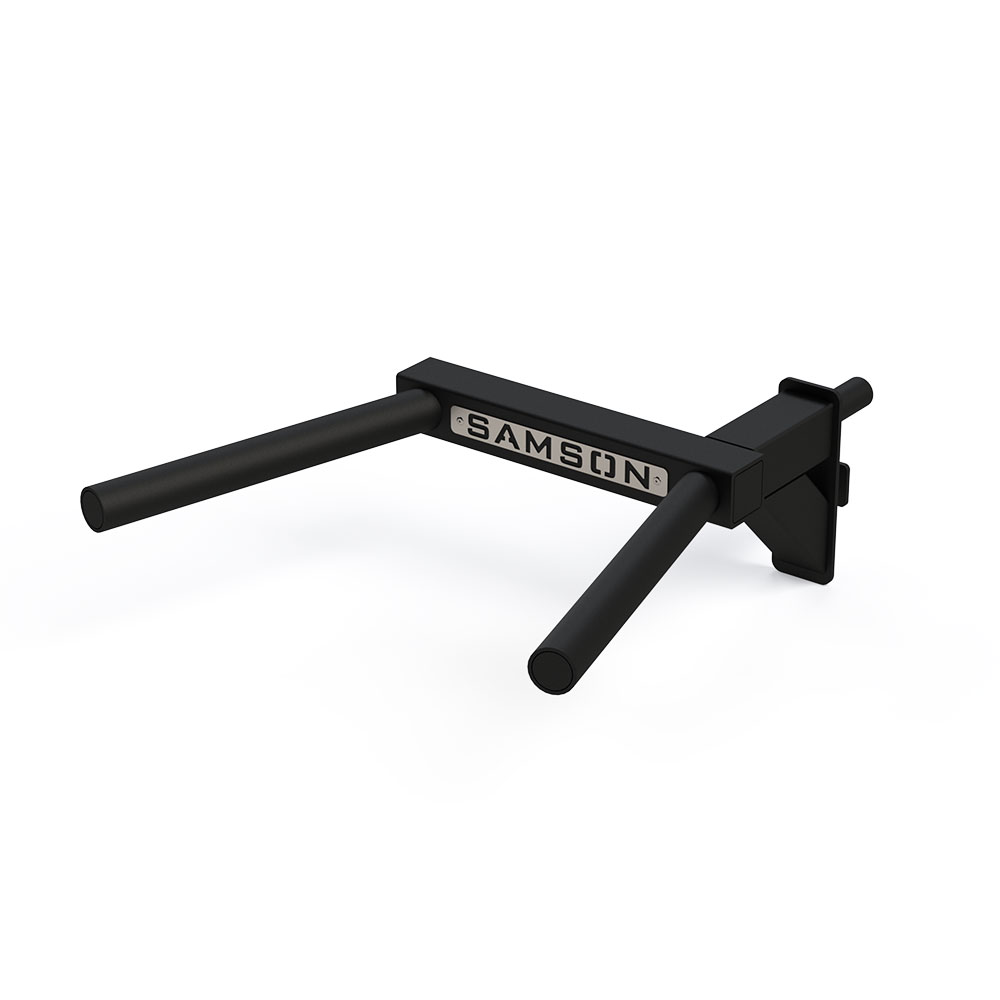
Dip Attachment for Power Racks: High-Value Upper-Body Training in a Small Footprint
In a well-designed weight room, racks and rigs are the backbone—but the accessories you add are what turn a rack line into a complete training system. A dip attachment expands the training options of a power rack by providing a dedicated station for dips, one of the most time-tested upper-body movements for building strength and resilience.
For schools, colleges, and tactical facilities, a dip attachment is a smart addition because it delivers a high training return without requiring a separate standalone machine. It supports station-based group training, bodyweight progressions, and athlete durability work across many sports.
Why dips remain a cornerstone movement
Dips can be programmed for strength, hypertrophy, and durability depending on how they’re coached and loaded. Many programs use dips to develop pressing strength and triceps capacity, and to build upper-body robustness for contact and collision sports.
- Scalable: can be bodyweight, band-assisted, or loaded depending on athlete level.
- Efficient: strong training stimulus without large equipment footprint.
- Station-friendly: works well in circuits and team training lanes.
- Durability support: builds pressing volume with a controlled movement option.
How a dip attachment fits in a rack-based training system
Racks are used constantly during team sessions. That’s why rack accessories are most valuable when they add options without disrupting flow. A dip attachment can be placed so it’s accessible during accessory blocks without interfering with squat/bench rotations.
Common facility use cases
- Accessory lane work: dips after main pressing to add volume and build triceps strength.
- Bodyweight stations: combine dips with pull-ups, trunk work, and carries for athletic circuits.
- Off-season development: loaded dip progressions to build upper-body strength.
- In-season maintenance: controlled sets that support strength without excessive fatigue.
Progressions that make the station usable for more athletes
In institutional settings, the best stations are the ones that can be scaled to many athletes. Coaches often implement dips using a progression approach so athletes can build capacity over time.
- Assisted variations: band assistance or controlled range of motion for beginners.
- Standard bodyweight reps: consistent strict reps for most athletes.
- Loaded progressions: additional load for advanced strength development when appropriate.
- Tempo emphasis: controlled reps to reinforce quality and reduce “bounce.”
Coaching notes for high-traffic rooms
During busy team sessions, stations need to be easy to coach and hard to misuse. A few simple rules help maintain quality and reduce risk:
- Standardize range of motion: define what a good rep looks like so athletes don’t chase sloppy depth.
- Control the shoulder position: cue athletes to stay controlled and avoid uncontrolled descent.
- Manage station flow: set clear rotation timing so athletes aren’t stacked up in a walkway.
- Keep the lane visible: place the station where coaches can see and cue quickly.
Planning guidance: placement, flow, and supervision
Accessories work best when they’re placed intentionally. In a high-traffic room, the difference between “useful” and “in the way” is often a few feet. When planning a dip attachment, consider:
- Traffic flow: keep dip stations out of the main barbell loading and walking lanes.
- Supervision: ensure coaches can see the station and cue technique.
- Clearances: allow athletes room to mount/dismount and complete reps safely.
- Programming reality: place it where it supports your rotations and time blocks.
If you’re designing a full rack line or planning a new facility, Samson can help you map out an efficient rack layout. Start here: Start Your Free 3D Layout Design.
Why rack accessories are a smart investment
Many facilities want more training variety but are constrained by square footage and budget. Accessories can be the best “value per square foot” purchases you make—especially when they attach to a station you already own and use every day.
Instead of adding a separate machine for every movement, a well-planned rack system lets you cover the biggest training needs with fewer pieces, while still giving athletes a professional training environment.
Build a complete rack plan
A dip attachment is one component of a rack solution. The best results come when racks, storage, and accessories are planned as a system. If you’re planning a room, explore Samson’s rack solutions and facility examples:
Pairing idea: dips + pull-ups as a simple bodyweight lane
Many facilities like to build a reliable bodyweight lane: pull-ups and dips are classic movements that scale well across athletes. When planned as a visible station lane, they support efficient rotations and keep athletes training hard without needing extra machines.
Ordering guidance and support
To ensure you get the right attachment for your rack configuration, it helps to confirm the specific rack setup you’re using and how you plan to run the station during group training. If you’re unsure what fits best for your space, Samson can help you decide based on the layout and your training flow.
For pricing, options, and planning assistance, reach out here: Contact Samson Equipment.
FAQs: Dip attachments
Is this only for advanced athletes?
No. Dips can be progressed and scaled. Many programs use assisted variations and gradually build capacity over time.
Will it slow down rack rotations?
Not if it’s planned well. The best rack accessories support accessory blocks and station flow without interfering with the main lifts.
Can Samson help us design a rack line?
Yes. Rack lines are often the most important feature of a facility. A layout-first approach ensures spacing, storage, and accessories work together.
Request Pricing and Layout Support
Want to get more out of your racks without adding more floor space? Add high-value accessories like a dip attachment and plan your rack line for efficient team training. Contact Samson to get started.
Ordering, support, and facility planning
In a high-volume facility, the right equipment is only part of the solution. Planning station counts, storage, and traffic flow helps teams train efficiently and keeps equipment in better condition long-term. If you’re building a new room or upgrading an existing space, Samson can help you choose the right mix of stations and accessories so the room works under real training volume.
For help selecting options, confirming fit, and building a complete equipment list, reach out here: Contact Samson Equipment. If you’re planning a full room layout, you can also start a free design conversation here: Start Your Free 3D Layout Design.
Quick FAQ
- Can Samson help with layout and station counts? Yes—layout-first planning improves throughput and daily usability.
- Do you support schools and team facilities? Yes—Samson equipment is built for repeated institutional use.
- How do we choose the right accessory mix? Match accessories to training goals, group size, and storage/organization plan.