Description
Step Up Rack Attachment
The Twist Lock Step Up gives coaches a straightforward way to add step-up work inside a Samson training environment without dedicating permanent floor space to a separate station. Step-ups remain one of the simplest ways to train unilateral lower-body strength, challenge balance, and reinforce controlled hip and knee mechanics. When the setup is stable and easy to position, the movement becomes much easier to program for large groups because athletes can rotate through clean reps without a long explanation or a cluttered setup. For many weight rooms, that matters more than adding another oversized piece of equipment. Coaches often need accessories that expand exercise options while still protecting open space for traffic flow, supervision, and plate movement. A rack-mounted step-up option helps facilities keep the room flexible. It can support lower-body training blocks, return-to-play progressions, and general athletic development work while staying aligned with the same planning logic that governs the rest of the room.
Where a step-up attachment fits in a training plan
Step-up variations are useful because they let coaches train single-leg strength with a clear starting position and a repeatable range of motion. In team settings, the exercise can be loaded, bodyweight-only, tempo-driven, or used as part of a contrast sequence depending on the training age of the group. That makes a product like the Twist Lock Step Up practical for high schools, colleges, private facilities, and other performance spaces where multiple athlete populations may share the same room. Because the movement starts from a stable elevated surface, coaches can use it to emphasize controlled force production, posture, and balance without asking athletes to learn a highly technical pattern first. It is also a strong option when a program wants lower-body work that does not depend on a large footprint. In a busy room, that can make the difference between a movement that gets programmed consistently and one that is skipped because the setup takes too much space or interrupts the training flow.
Why room layout and attachment strategy matter
Accessories work best when they are evaluated as part of the full room plan. A step-up attachment should be considered alongside rack spacing, nearby storage, athlete traffic paths, and the way groups move through a session. If a room is tight, coaches need equipment that supports fast transitions. If a room serves football, baseball, basketball, Olympic sports, or private clients in overlapping blocks, the equipment mix needs to stay versatile without creating extra congestion. The Twist Lock Step Up is valuable in that context because it can add exercise variety without forcing a facility to carve out dedicated floor space for a standalone setup. That kind of decision becomes even more important when a program is trying to increase training density while still preserving coaching visibility and safe movement patterns. Good room design is rarely about packing in the highest number of pieces. It is about choosing equipment that allows more useful work to happen inside the same footprint.
What coaches and buyers should evaluate before ordering
Before adding any accessory to a rack system, it helps to think through who will use it most often, how it will be loaded, and how quickly staff members need to move athletes through the station. The right answer is not always the most complicated answer. Many facilities simply need dependable attachments that are easy to position, intuitive for athletes, and durable enough for repeated daily use. In those environments, ease of use and long-term reliability often matter as much as any single programming idea. Buyers should also review how the attachment supports their broader lower-body training menu. For some rooms, the value is adding a clean unilateral option alongside squatting, hinging, and jumping work. For others, the benefit is having a practical way to progress athletes who need more controlled single-leg training. The stronger the fit between the accessory and the coaching plan, the more often the equipment will stay in rotation instead of becoming something that sits on the edge of the room.
Common use cases in high-performance facilities
In collegiate and scholastic weight rooms, step-up work is often programmed for unilateral force production, movement quality, and training balance across the year. It can fit into offseason strength blocks, in-season maintenance work, and introductory progressions for younger athletes. In private training settings, it may be used to support athletes who need clean single-leg loading patterns while coaches manage different ability levels in the same session. In both cases, the equipment needs to feel solid, repeatable, and easy to integrate with the rest of the room. That is why Samson clients often look beyond the product photo and ask bigger planning questions. How many racks need this option nearby? Where should plates or dumbbells sit to keep transitions smooth? How close can stations be placed before traffic patterns start breaking down? Thinking through those details early leads to a better room. It also makes sure an accessory like the Twist Lock Step Up supports the daily coaching environment rather than creating one more setup problem to manage.
Construction, footprint, and finish
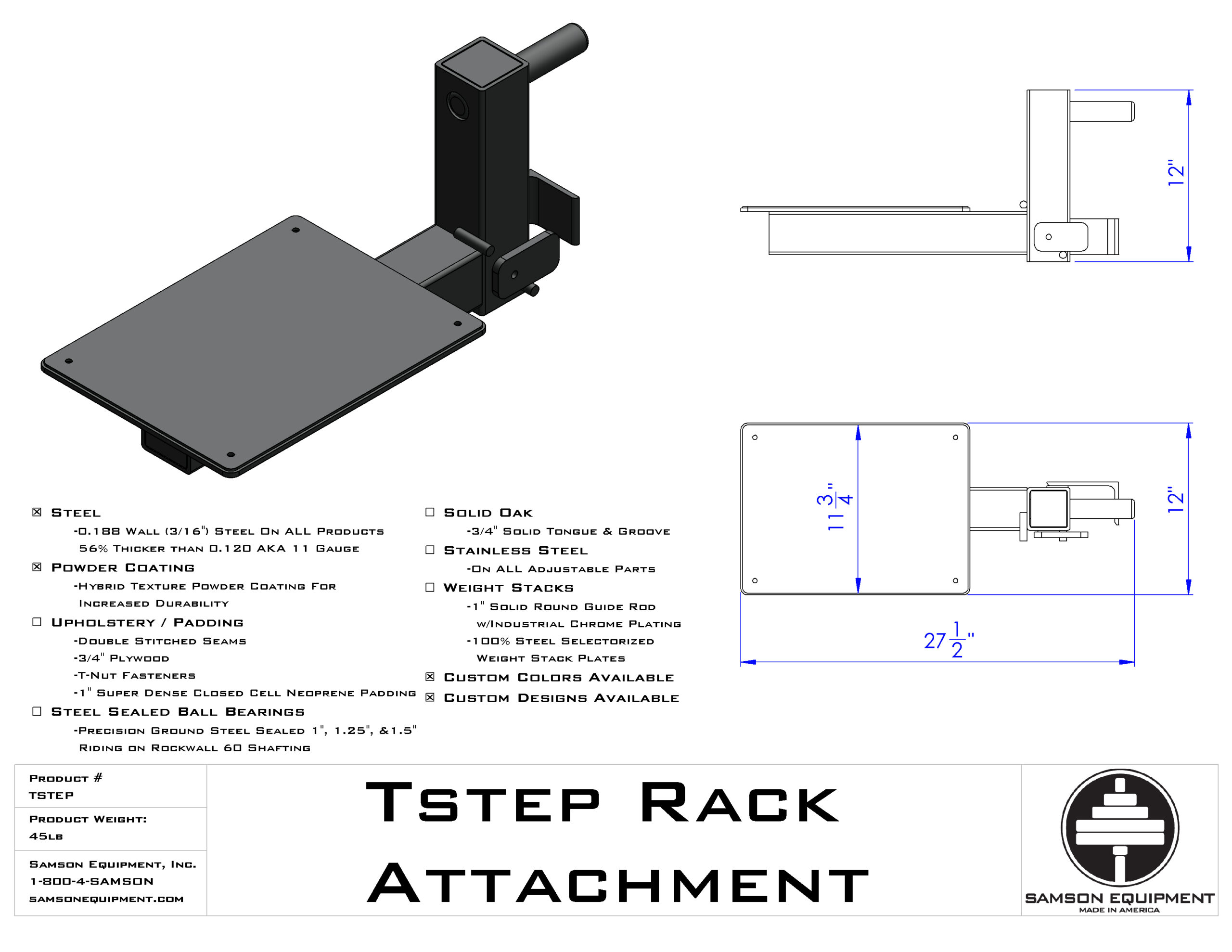
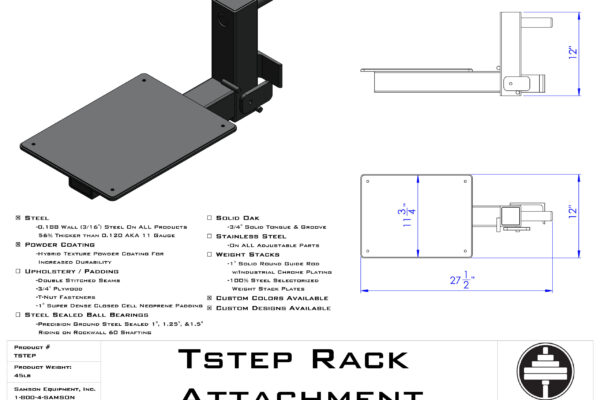
The cut sheet adds practical details that matter when coaches and facility planners are comparing attachments for a real room buildout. The Twist Lock Step Up uses 3/16 inch wall steel and a hybrid texture powder coating for increased durability, which makes it a better fit for repeated institutional use than lighter-duty accessories built for occasional use. That construction matters in high school, college, and private training settings where attachments are moved, loaded, and used by large groups across multiple sessions every day.
The platform footprint is compact enough to add single-leg training options without demanding a large permanent station. The cut sheet lists the attachment at 27 1/2 inches long, 13 3/4 inches wide, and 12 inches high, with a product weight of 45 pounds. That gives coaches a clearer idea of how the attachment fits into rack spacing, nearby storage decisions, and athlete traffic flow. For programs trying to expand exercise variety while preserving room efficiency, those dimensions are as important as the movement itself.
The same sheet also confirms custom colors and custom designs are available. That gives facilities more flexibility when they need an attachment to match an existing Samson room package, a school color palette, or a broader custom equipment plan. Combined with Samson’s layout support, those details make the Twist Lock Step Up easier to evaluate as part of a complete room rather than as an isolated accessory purchase.
Helpful next steps
- Browse Samson product categories to compare related racks, benches, storage, and training accessories.
- Contact Samson Equipment to discuss pricing, compatibility questions, and recommended equipment mixes.
- Start your free 3D layout design if you are planning a new room or reworking an existing facility.
Request Pricing and Layout Support
If you are deciding whether the Twist Lock Step Up belongs in your room, Samson can help you evaluate fit, quantity, and placement based on your athletes, training flow, and available space. Reach out for pricing, layout guidance, and a practical recommendation that matches the way your facility actually trains.
Product Specifications
| Product Number | TSTEP |
|---|---|
| Dimensions | 27 1/2 in. L x 13 3/4 in. W x 12 in. H |
| Product Weight | 45 lb |
| Construction | 0.188 wall (3/16 in.) steel |
| Finish | Hybrid texture powder coating |
| Custom Colors | Available |
| Custom Designs | Available |
| Made In | America |