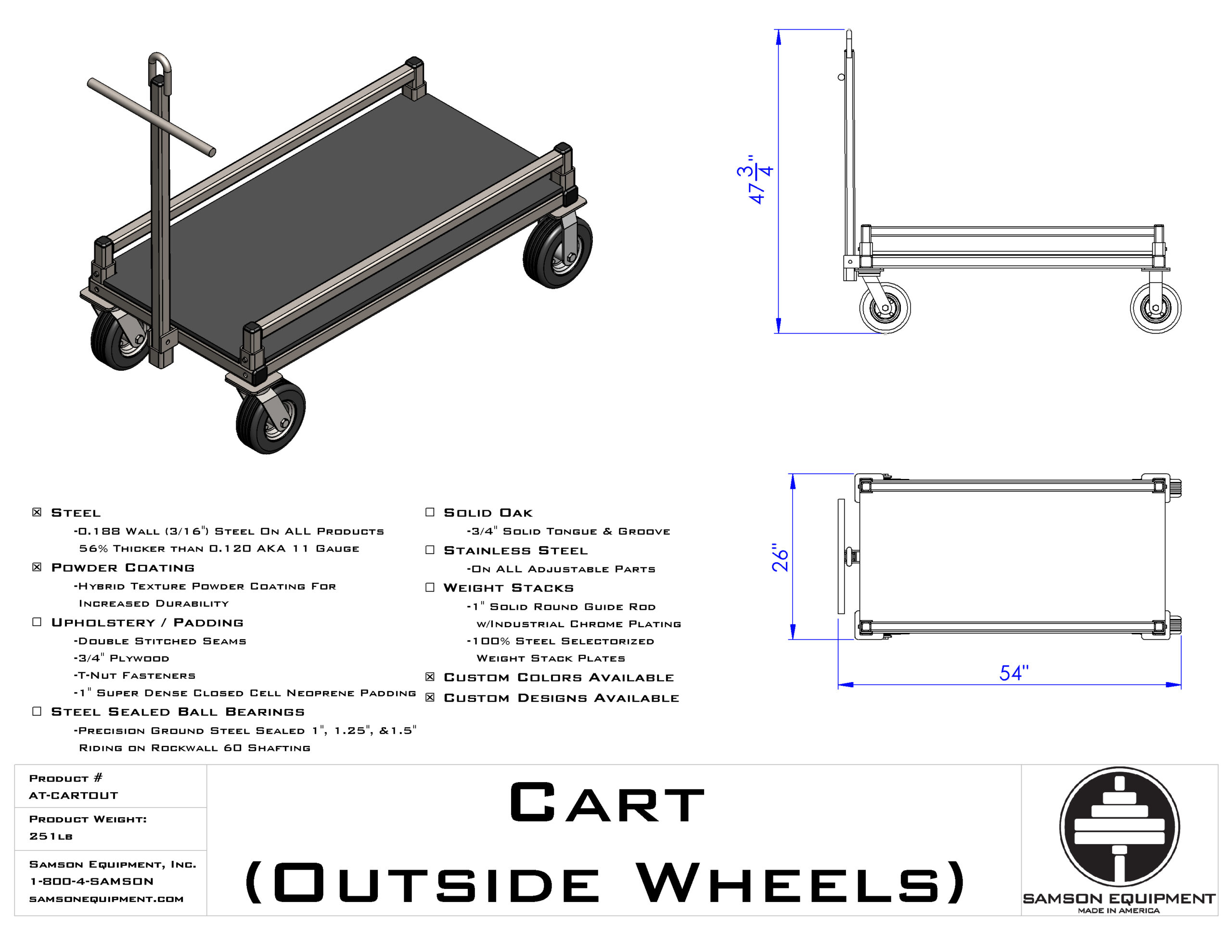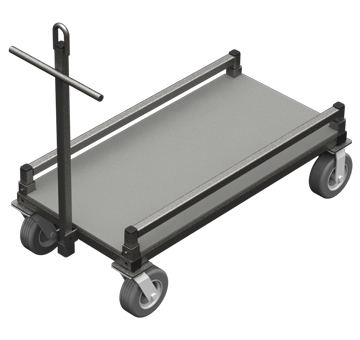
Cart with Outside Wheels and 1160 lb Capacity
The Cart with outside wheels and 1160 lb capacity is built for programs that want a high-capacity mobile support piece and prefer the wider wheel stance that comes with an outside-wheel design. In an athletic training environment, the value of a cart is not only that it moves. The value is that it helps staff transport equipment, support items, or bulk materials without breaking the rhythm of the room. When several athletes, coaches, or trainers are moving through the same area, stability, access, and usable floor space all start to matter together. A heavy-duty cart can play an important role in that daily rhythm when its footprint matches the way the room is actually used.
Because this model is rated at 1160 lb capacity, it belongs in conversations about demanding environments, not just basic convenience. Programs that regularly move supplies or larger support loads can benefit from a cart that is meant for real work. The outside-wheel layout also gives buyers an alternative to the Cart with inside wheels and 1160 lb capacity, which is why both models deserve a close look before a purchase decision is made. Rather than assuming there is a one-size-fits-all answer, the smarter move is to evaluate which wheel layout best serves your routes, your storage expectations, and your daily staff flow.
Why Programs Choose the Outside-Wheel Configuration
An outside-wheel layout changes how the cart presents itself in the room. Some buyers prefer that wider stance because it aligns better with the way they load, move, and park the cart during busy days. The key is not to reduce the decision to a simple spec comparison. The key is to think about where the cart starts, where it travels, and where it ends up during real training-room use. In a larger room, or in environments where a broader base feels more natural to staff, an outside-wheel design may be the better fit.
This is also why Samson customers often compare carts to nearby workstations. A mobile cart should complement fixed pieces like the Single Taping Table, the Taping Table with Backrest, or a 6′ Treatment Table rather than create friction around them. When the equipment plan is aligned, the room is easier to keep organized, easier to clean, and easier for athletes to move through between practice, treatment, and recovery.
What buyers often value in this model
- A stated 1160 lb capacity supports heavier-duty transport needs.
- The outside-wheel configuration gives buyers another layout option to match their room.
- Mobility helps staff take support items where they are needed instead of clustering them at one counter.
- The cart can be planned alongside taping, treatment, storage, and hydration stations.
- Comparing both cart configurations can lead to a more intentional training-room layout.
Build the Room Around Workflow, Not Random Add-Ons
Mobile support pieces matter because athletic training does not happen in a single fixed spot. Supplies move from taping area to treatment area, from hallway to practice court, and from pre-practice setup to post-practice cleanup. A cart that belongs in that workflow should help staff stage what they need before the rush begins and keep items close once athletes start rotating through the room. That is why many buyers compare cart configurations alongside their core Athletic Training Tables, because the best support piece is the one that shortens steps, protects usable floor space, and helps the room stay organized when several athletes need attention at once.
The best results usually come when a program maps the whole room instead of buying one piece at a time. A cart may support hydration beside the Beverage Cart, short-term staging near the Single Taping Table W/ Shelf and Drawer, or back-end transport in the same zone as a Drying Rack 60 x 60 x 24. Those choices depend on staff habits and room size, but the larger point is the same: support pieces should work together. When they do, staff spends less time improvising around clutter and more time with athletes.
Think Through Routes, Parking, and Use Frequency
Before choosing this cart, think through your daily routes and where the unit will live when it is not moving. Consider who uses it, what it carries, and whether the cart needs to serve one room or multiple spaces over the course of the day. Those questions help define whether this outside-wheel layout is the better fit than the inside-wheel model. Capacity matters, but day-to-day flow matters just as much.
Samson works with programs that want to build rooms around real operating demands. Reviewing the broader Athletic Training Tables category and then speaking with contact Samson Equipment can help your team narrow the right combination of carts, taping stations, treatment tables, and storage accessories before the room is finalized.
Talk with Samson About the Right Cart Setup
If you are deciding between the inside-wheel and outside-wheel configurations, or trying to build a more efficient athletic training room overall, start with the full Athletic Training Tables lineup and then contact Samson Equipment. Samson can help you compare related products, align support pieces with how your staff works, and create a room that functions better under everyday training demands.
Match the Cart Footprint to the Space Around It
Wheel layout decisions become clearer when buyers think about how the cart will be loaded, rolled, parked, and approached by staff in real time. A room with more open circulation space may benefit from the outside-wheel configuration because the stance can align naturally with the way the cart is handled and staged during the day. The goal is not to force one design into every setting. The goal is to choose the cart that feels most natural in the room your staff actually runs.
That is why it helps to evaluate the cart in context. Look at where taping happens, where treatment happens, where hydration or bulk support items are staged, and how staff resets the room after the rush. When the cart footprint matches those tasks, the room feels smoother. When it does not, even a high-capacity cart can become harder to use than it should be.
Product Specifications
| Dimensions | N/A |
|---|