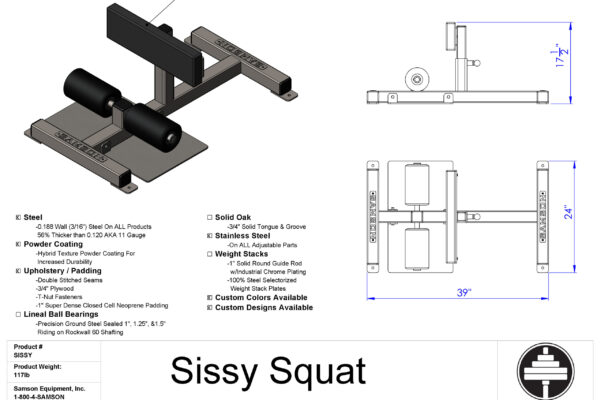
Product Specifications
| SKU | SISSY |
|---|---|
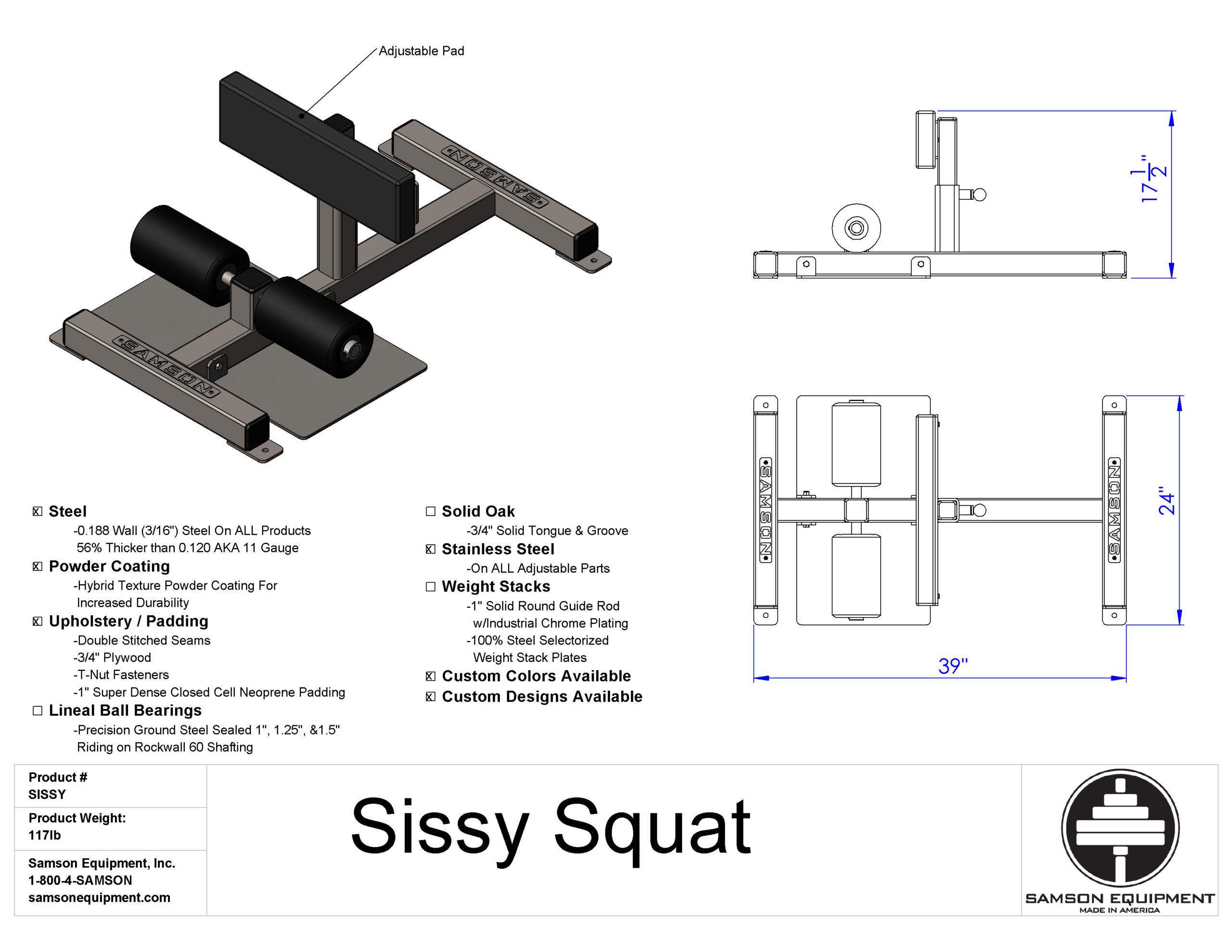
| Dimensions | 39" L x 24" W x 17.5" H |
| Product Weight | 117 lb |
| Pad | Adjustable pad |
| Construction | 0.188" wall (3/16") steel construction |
| Finish | Hybrid texture powder coating for increased durability |
| Upholstery | Double-stitched seams, 3/4" plywood, T-nut fasteners, and super-dense closed-cell neoprene padding |
| Options | Custom colors and custom designs available |
Sissy Squat Station: Compact Lower-Body Accessory Training
In a high-functioning strength program, accessory stations are where durability and training quality get reinforced. A sissy squat station is a compact lower-body accessory tool that can support targeted quad-focused training and controlled knee-dominant patterns. For institutional facilities, the value is simple: add useful lower-body accessory work without adding a large machine footprint.
When planned as part of an accessory zone, a sissy squat station can help coaches build better training variety, add controlled volume, and keep athletes moving through a session efficiently.
Why accessory stations are valuable in team facilities
Large group training creates constraints: time, supervision, and bottlenecks. Accessory stations help distribute athletes across the room, reduce backups at primary equipment, and make it easier to run rotations that keep everyone training with intent.
- Throughput: add another lower-body station to keep groups moving.
- Variety without complexity: one station can support multiple programming goals.
- Durability focus: controlled accessory volume can support long-term resilience.
- Space efficiency: add capability without dedicating space to a large machine.
How a sissy squat station can fit in programming
Coaches program lower-body accessories differently depending on sport demands and training phases. A sissy squat station is often used as supplemental work rather than as a primary strength driver. It’s a tool for targeted volume and controlled execution.
Common programming uses
- Accessory lane work: quad-focused sets after primary squats or hinge patterns.
- In-season maintenance: controlled volume to support strength without excessive fatigue.
- Circuit training: one station inside a rotation with trunk work and posterior chain accessories.
- Movement quality emphasis: coached tempo and control for athletes who need better lower-body mechanics.
Progressions and regressions (make it usable for more athletes)
In team environments, the value of an accessory station comes from how many athletes can use it safely and effectively. Coaches often scale the station by adjusting range of motion, tempo, and volume. That helps beginners train with control while allowing advanced athletes to build meaningful accessory volume.
- Beginner focus: shorter ranges of motion and slower tempo for control.
- Intermediate progression: consistent full reps with standard rest and volume.
- Advanced emphasis: controlled high-quality volume as a targeted accessory block.
Coaching notes: make the station high-quality, not chaotic
Accessory stations can become “junk volume” if they aren’t coached. A few simple rules make the station more effective and safer:
- Coach tempo: controlled reps reduce bounce and improve training value.
- Standardize setup: athletes should know where feet and hips go to keep reps consistent.
- Keep it in the accessory zone: avoid placing it in a main traffic lane where athletes are crossing.
- Use clear station timing: set a consistent time block so rotations stay smooth.
Facility planning: where to put it
Small equipment can still create problems if it’s placed randomly. The best location is typically near other accessory stations, not in the middle of the rack lane or the main dumbbell walkway. This keeps athletes from crossing traffic and helps coaches supervise accessory work.
Placement tips:
- Keep it visible: accessory stations should be coachable, not hidden in a corner.
- Avoid bottlenecks: place it outside the main path between racks and storage.
- Build an accessory zone: group small footprint stations together so rotations are easy.
- Plan for storage: ensure nearby storage keeps accessories and plates organized.
Pair it with other stations for better flow
Accessory zones work best when athletes can rotate through complementary movements without walking across the room. Many facilities pair a quad-focused station with trunk work and posterior chain accessories so sessions remain balanced. Planning these clusters reduces downtime and makes supervision easier.
If your current accessory work creates bottlenecks at benches or dumbbells, adding a few dedicated small-footprint stations can improve throughput without changing your entire equipment plan.
Plan the room around how you train
The most common mistake in facility builds is choosing equipment first and trying to “make it fit” later. A better approach is to start with athlete flow and station needs, then select equipment that supports how you coach. Samson can help you visualize the room before you buy, so the final space runs well during real training blocks.
Start your layout here: Start Your Free 3D Layout Design.
Build a complete accessory and free-weight plan
Accessory stations work best when they complement the primary equipment in the room. If you’re building or renovating, it helps to plan benches, storage, racks, and accessories as one system. Explore the broader equipment categories and facility examples:
Ordering guidance and support
If you’re unsure whether this station fits your facility plan, or if you want help building an accessory zone that supports your programming, the Samson team can help. Share your room dimensions, group sizes, and training style so recommendations match your real needs.
For pricing, options, and planning support, reach out here: Contact Samson Equipment.
FAQs: Sissy squat stations
Is this a replacement for primary lower-body training?
No. Most programs use it as supplemental accessory work that supports the main lifts.
Is it useful in team training environments?
Yes—especially when you run stations. It can help distribute athletes across the room and reduce bottlenecks at higher-demand equipment.
Can Samson help us plan an accessory zone?
Yes. A layout-first plan helps ensure your accessory stations support flow, visibility, and safety.
Should we add one station or multiple?
That depends on group size and how much accessory time you run. Samson can help you plan station counts based on the number of athletes training simultaneously and the lane flow in your layout.
Request Pricing and Layout Support
Want more lower-body accessory options without adding a large machine footprint? Add a sissy squat station and plan an accessory zone that keeps athletes moving. Contact Samson to talk through your facility plan.
Ordering, support, and facility planning
In a high-volume facility, the right equipment is only part of the solution. Planning station counts, storage, and traffic flow helps teams train efficiently and keeps equipment in better condition long-term. If you’re building a new room or upgrading an existing space, Samson can help you choose the right mix of stations and accessories so the room works under real training volume.
For help selecting options, confirming fit, and building a complete equipment list, reach out here: Contact Samson Equipment. If you’re planning a full room layout, you can also start a free design conversation here: Start Your Free 3D Layout Design.
Quick FAQ
- Does Samson offer accessories and attachments? Yes, Samson offers a wide range of accessories and attachments for training rooms.
- What should guide accessory selection? Training goals, group size, storage, and athlete rotation should guide the accessory plan.
- Can Samson help if an accessory need is not listed? Yes, contact Samson with the specific need so the team can review available options.