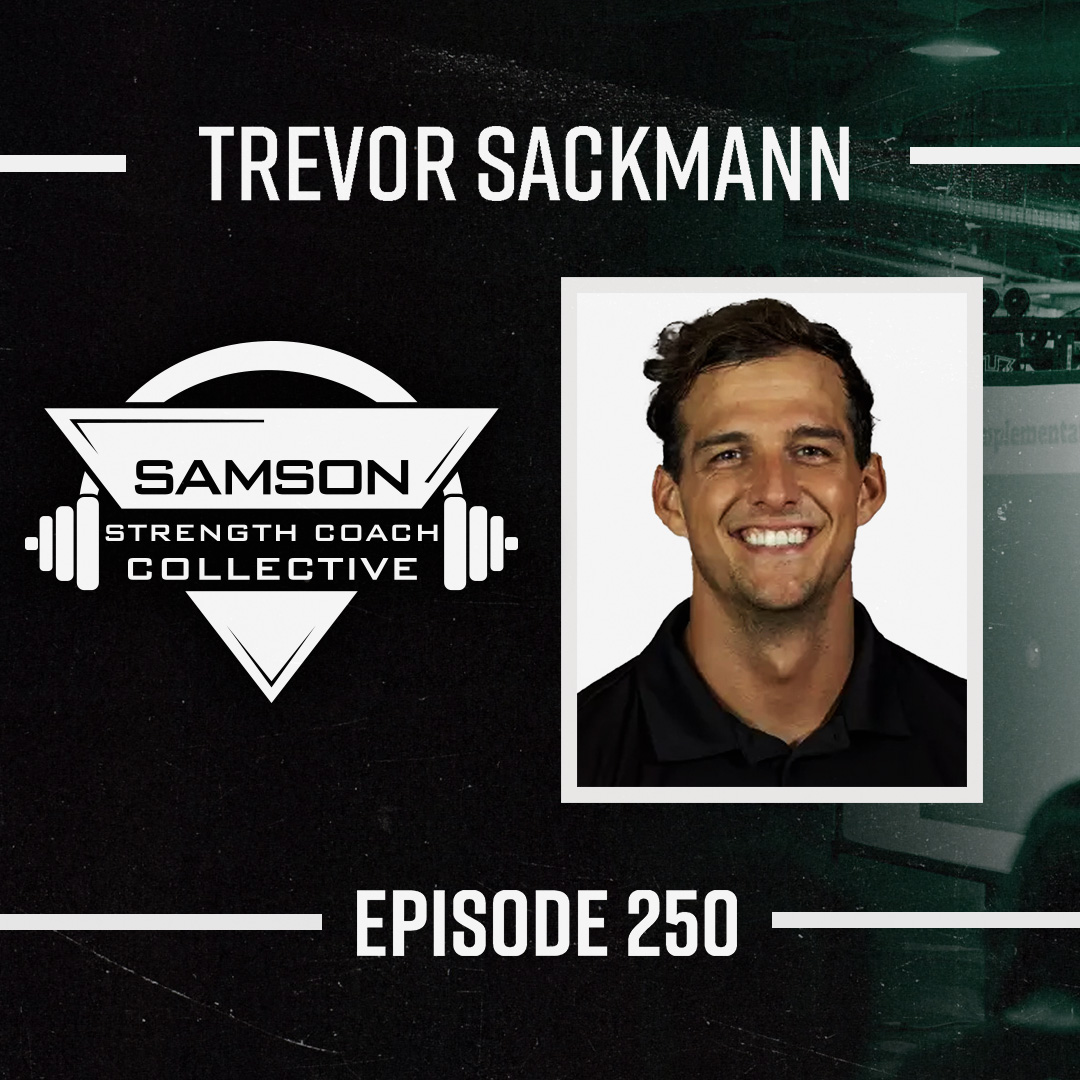
Trevor Sackmann, Assistant Strength and Conditioning Coach at the University of Hawaii, joins the Samson Strength Coach Collective to discuss how the role of the strength coach continues to evolve. Drawing from a unique career path that included coaching internationally in China and developing athletes in college settings, Trevor explains why today’s strength coach must be more than a weight room specialist.
Throughout the conversation, Trevor highlights the importance of communication, collaboration, athlete monitoring, and developing trust with sport coaches. He shares practical lessons on using technology to support conversations, understanding the bigger picture of athlete development, and learning how to create buy-in from both athletes and staff. This episode is a strong reminder that the best strength coaches are not just writing programs. They are helping lead the entire performance process.
Key Takeaways
- The modern strength coach must add value outside the weight room
- Communication and collaboration often have more impact than the perfect program
- Technology can help open doors to better conversations with sport coaches
- Athlete monitoring becomes more useful when paired with trust and context
- Buy-in from athletes and coaches can drive better outcomes than rigid programming
- Long-term development requires flexibility, patience, and perspective
- Growth as a coach often comes through criticism, discomfort, and adapting your approach
Quote
“The strength and conditioning coach more often than not is bound to the weight room, but the best coaches find ways to expand their value beyond it.”
— Trevor Sackmann
Trevor Sackmann (00:00)
The strength conditioning coach more often than not is bound to the weight room, right? And at least the perception of the strength coach is very weight room oriented. ⁓
but how I’ve seen my own career progress and my own role progress and how I am seeing it, because like, this is again mentorship and collaboration that I’ve had with other people that are much more successful and smarter than I am. But how I think every young coach can kind of look at their own career and the steps within that career, not only like,
jumping roles, but within your role, how you can continue to add value and expand it is making your way, making, you know, not being bound to the confines of the weight room and finding yourself.
Samson (01:06)
What’s going on, Samson Strength Coach collective listeners? On today’s episode, we have Trevor Sackman, Assistant Strength and Conditioning Coach for the University of Hawaii. He’s got the Aloha shirt on. We’re stoked to have you and very excited to have you on the show. Thanks for coming on.
Trevor Sackmann (01:21)
Yeah, thanks Connor. Thanks for having me. Long time coming.
Samson (01:23)
Absolutely.
man, well exactly. And we were just talking about Ryan previously and now I get to speak with you. And so I’ll text Ryan after this and let him know that you were a fantastic guest or a bad guest. I’ll be honest with them. So.
Trevor Sackmann (01:37)
Can’t wait to hear his response.
Samson (01:39)
Excellent, excellent. Well, can you just give us a breakdown of your career, ⁓ kind of your history within strength and conditioning and then what you’re up to now at Hawaii?
Trevor Sackmann (01:50)
So my career was kickstarted at the University of Oregon. So that’s where I got my undergraduate degree in my senior year at Oregon was when I really decided that I wanted to pursue. I was a personal trainer at the student rec center. Unfortunately, I wasn’t athletic enough ever to play division one athletics. I would like to say 12 time intramural champion at the University of Oregon.
Sixth football championship specifically. ⁓ Big deal, big deal. Yeah. But anyways, you know, I thought I wanted to play collegiate athletics. ⁓ And then I get to college and, ⁓ you know, you’re not gonna have to try to walk on to various sports and never worked out. But anyways, besides the point, you’re without
Samson (02:21)
It’s a big deal, it’s a big deal, let’s not ⁓ disregard that.
Trevor Sackmann (02:47)
kind of that team setting that you’ve always ⁓ existed in. I was studying human physiology at Oregon, thinking about what I wanted my potential career to look like. ⁓ At first, looking at med school, physical therapy, and I got into personal training at the student rec center and I thought it was pretty cool, obviously working with people one-on-one.
Not being in the athletic setting, I wanted to explore other opportunities, maybe working with teams. So I reached out to Coach Radcliffe, the head strength and conditioning coach at the University of Oregon. He was fortunate enough to let me come intern for him for a semester. you know, I walk in the door and I see for the first time how, what strength and conditioning looks like. Not only on the, from the team side of things, having worked in one-on-one with people as a personal trainer, but at a place like the University of Oregon.
the from the second I walked in those facilities and and heard him address the team. was like, okay, this is it. This is it. This is unlike anything I’ve ever seen before. I know absolutely nothing. I know nothing. This guy is like, you know, he’s Jesus to me. I want to emulate him. I want to be him. I hope one day I can take his job. ⁓ But that was pretty cool. You know, early on,
being really inspired by an individual gaining some mentorship from Coach Radcliffe. And then the GA that was there at the time, Matthew Voss, I became really close with him. He’s actually a director of strength nursing at the Chicago Bulls right now. But nonetheless, just worked with some really influential people that had a huge impact on me and that kind of kickstarted everything. So after that, read some books, CEO strength coach, it’s like, okay, what do you do?
You intern until maybe you get a GA. Once you get a GA, hopefully you become an assistant and kind of climb the ladder from there. So after Oregon, moved up to University of Oregon, moved up to Portland. Got an internship at a private facility up there for a few months while I was applying to like other various professional internships. My internship at Oregon was just a student intern. You show up at, you know, 6 a.m. before class, et cetera.
And then I was fortunate enough, I got offered an internship opportunity at Stanford University. So went down there, interned there for six months as a professional internship. And then after the six month mark, got hired as a part-time assistant. So that was pretty cool. Up until that point, I was like, all right, this is going to climb a ladder. Here we go. We’re rolling. And then I was offered an opportunity, and this is the most random thing ever. I was offered an opportunity to co-work in China.
with the Chinese youth national swim team. And people always ask like what the so ran, how does that an opportunity like that come about? Cause it was nothing that I had ever, you know, I didn’t seek it out and even necessarily apply. ⁓ but a colleague, at Stanford, her former classmate at Springfield college, ⁓ was visiting and he happened to be like a
recruiter for the Chinese Olympic Committee. And he got word that I was working with the men’s swim team. That was my first ⁓ team that I ever took charge of once I was hired as a part-time assistant was men’s swimming. I had done that for like, it was maybe two months into being a part-time assistant. But nonetheless, ⁓ they saw men’s swimming and, you know, Stanford swimming, especially on the women’s side of things, they had like four gold medalists.
Swim on the, on the woman’s side at Stanford at the time. So, the Chinese Olympic committee was, was doing everything they could to get, to get, ⁓ the coaches that, that maybe led to some of that success over to help out their teams. But anyways, I sat down with them for a lunch because it was free and I was making very little money. and they offered the opportunity to the, to the woman’s coach and he was like, no, no, I’m good. He had been pretty established in his career, ⁓ at Stanford at the time. And then they looked at me cause I’m.
I guess I’m the swimming expert and offered the position to me. And then after some discussions with my family and myself, this is an opportunity to get some international experience at the age of 23 at a level that was far beyond what I believed I would be able to work out at the time. So I set that position and then two weeks later,
I moved over to Beijing, China, where I spent the next year and a half working with elite youth swimmers within that country. And then as we all know, COVID happened. ⁓ That kind of put an end to things pretty quickly. I had to evacuate the country and make my way home. And after a year of spending time back at my parents’ house, enjoying time with my folks, ⁓ an opportunity at
University of Hawaii opened up for a GA position and I didn’t have a master’s degree at the time and it made a lot of sense to ⁓ head there. accepted that position after two years as a GA that did a good enough job that they offered me an assistant position. That’s where I’ve been for the last year, six now, four as a full-time assistant.
Samson (08:21)
I mean, what an awesome story, man. It’s so cool just to hear about that experience. you know, I think a lot of people can relate to that where it’s, you know, I’m taking a job that, you know, I may not feel like I’m necessarily ready for. I’ve only had two months experience in this specific realm. And then all of a sudden I’m going out to China to internationally work. Right. I mean, how was it to go out there? What was your first couple of weeks like? And then how did it progress as you went through a year and a half of being in China and starting to catch your rhythm?
Trevor Sackmann (08:23)
Yeah.
Yeah.
Yeah, sure. ⁓ Culture shock for sure. Culture shock for sure. There is, I’ve never, so in my free time, I love traveling. I’ve been to lot of places around the world. The little time that I get off in this industry, I’m out. I’m all around the world. ⁓ And even with that said, I have never been to this day anywhere like China. It’s just completely different than anything I’ve ever experienced.
You know, at first, you know, was like, WTF am I doing here? What did I sign up for? You know, I’m 5000 miles away. ⁓ You know, and I haven’t seen blue sky in a week. What is this? It’s not fog. That’s for sure. ⁓ But, you know, that was that was just the initial shock. It was.
It was interesting. So none of my athletes spoke any English. And the way it was set up is we had a manager. She was she was Chinese. We had an American swim coach myself and then a ⁓ physio or an AT who was also also American. And then we had two assistants and their only job was just to translate for all of us. So here I am kind of trying to do things the way I normally do.
but it’s taking two to three times as long because everything I’m saying, you know, is having to be translated into another language. And not only English to Chinese, English strength and conditioning into, you know, Chinese strength conditioning was bizarre. But nonetheless, from a coaching standpoint, it really forced me to be very good with kind of my nonverbal communication, my demonstrations, and making things like as simple as possible.
Right. Early on in your career. ⁓ I was at Oregon, I was at Stanford. know all of these things and it’s like, well, it doesn’t matter. You’re, trying to communicate with a 14 year old. It’s one of the best swimmers in, know, in, in the country and you got to translate it through this other 18 year old, you know, you need to keep things as, as simple as possible. ⁓ but once I found the groove in that, I mean, these were.
kids, you know, from the kids perspective, they were so unbelievably hardworking, eager to be successful and bring like a ⁓ pride to like their family and their country. Because the Olympic kind of system out there, ⁓ it’s, it’s sponsored in the sense that, ⁓ you know, you’re kind of selected, if you’re if you’re talented, to go train.
with these national teams or kind of these subgroups from like a fairly young age. And it’s not like forcibly, know like, there’s media can shift it one way or another, but it’s more so, you hey, you have the opportunity here to, you know, become a world champion. We have identified, is this something that you wanna pursue? And in a country like as competitive,
⁓ as China, especially on the academic side, if you have the opportunity, ⁓ athletically to be the best at anything, ⁓ you know, the parents are going to push their kids out the door and yes, you know, go for it. ⁓ so, ⁓ kids who are just, they were, they were taking some, ⁓ some school kind of online a little bit, but it was, it was more or less, you know, training full time, six, seven days a week. and so I couldn’t train them.
you know, not only from a translation standpoint, I couldn’t train them like the Stanford athletes, know, that not only like, you know, cognitively and developmentally. But these are kids who are essentially being treated as professional athletes pretty early on. So a lot of my training became like playground fun. know, there’s the
There’s positive and negatives of early sports specialization, but as we know in the sport of swimming, there’s a huge burnout rate and you people who are ending their careers fairly early due to just the high volumes and stress of swimming at such an early age. ⁓ I did as much as I could to keep it as fun and playful. ⁓
as possible, gamified training as much as I could, kept it very general because at the end of the day, like, yeah, I’m working with 12, 13, 14 year olds who aren’t getting, you know, A, from a developmental standpoint, and B, socially, cognitively, you want them to feel a sense of normalcy in their lives, right? So that was received so unbelievably well by the athletes early on, it was very easy.
took a while for the managers, especially the managers of the managers to understand what the heck this guy is doing. We hired this guy to develop world champions and he’s out here having them crawl and roll and play dodgeball. Like what does this have to do with swimming? But at the end of the day, I explained to them, they hired me because they wanted to adopt an American model.
and part of the American model and in terms of long-term athletic development, at least the good sides of it, is the sense of kind of play and ⁓ general training ⁓ that will yield longer results in the long term. ⁓ But once we were rolling, man, I fell in love with that place. If it wasn’t for COVID, there is a small chance that I would still be there.
Beijing and again, no one who’s lived in China. No one talks about China. All you hear is that, you know, the politics and the media and all these, you know, issues that we have with our government and trade and stuff. But the people outside of my team were, I was a celebrity. guess, we’re being completely honest, a white, a six foot tall white male, they were like, this is Tom Cruise. I have people.
pushing their kids into me to take pictures, because they’ve just never seen anyone like me, or they think I’m a freaking movie star. But I never faced any sort of ⁓ anger, frustration, or backlash from any people for leaving their country. They’re unbelievably grateful for me to be there and to share my knowledge with the people of China and Beijing. anyone who’s listening, maybe China hasn’t necessarily been on the radar, but
Beijing and Shanghai have been over the last few years ranked as one of the top 20 cities in the entire world to live. Shanghai is like the Paris of the East. So ⁓ you just have tons and tons of international influence there. Amazing, beautiful news, skyscrapers, the food is insane. And Beijing feels like New York City. ⁓ It’s been the capital for hundreds of…
maybe thousands of years and you have a city built on top of that. So it’s kind of new meets old. ⁓ But life there became like pretty easy, right? It was weird as a Colorado kid, ⁓ grew up kind of in the mountains not to have the nature of the green space that I was used to. But if you’re an individual that likes big cities and ⁓ the hustle bustle of city life, it was cool, man. It was cool. I loved it. And especially in the cherry on top of having one team.
And one responsibility. ⁓ man. Amazing. Amazing.
Samson (16:50)
Well, it just sounds
like such an awesome experience. And while you’re talking about the translators, like all I can think about was like, what could possibly be the Chinese word for it’s a lateral, right? Like there’s got to be some difficulties with that. ⁓ But I mean, like you said, there’s some really cool lessons that you got within there too, which is, obviously your nonverbal communication, having to be on point with your, you know, demonstrations and queuing and finding out, okay, this is how will commit.
Trevor Sackmann (17:00)
Yeah, No, it was a whole lot of like right, left.
Samson (17:19)
you know, work with these athletes. And then another piece too is obviously going to be your growth as a coach. And I commend you for going the path where, you know, you were going to do what you know is best for the athletes as a young strength coach, because I think that’s tough to follow, especially, I think in myself in that situation, I’d really struggle with, you know, okay, I know what’s going to be best for long-term development. But I’ve got, you know, like you said, the managers of the managers thinking they…
They’ve hired the pinnacle of strength and conditioning. And so what the heck is he doing playing dodgeball? I commend you for that because ⁓ it takes a certain amount of confidence in what you do. But I think it’s a great lesson as well for our listeners. There’s always gonna be times where you kind of get challenged on what you do, but ultimately it’s gonna come out best when you know you’re doing what’s best for the athletes.
Trevor Sackmann (18:06)
Yeah, I was fortunate. I my mentor is the prior to arriving in China, kind of established that that into me. And it’s funny now because I feel like I will compromise in the right word. There’s a lot more give and take now on the at the collegiate level, especially like, like not even close than there was back then part of it was just
⁓ being young and hard-headed. But the other part was, mean, if I’m gonna move 5,000 miles away from my family and you expect me to do this job, you need to trust, you need to trust that I can do it, right? Because if I’m not able to do these things that you brought me halfway across the world to do, what’s the point of me being here, right? ⁓ Clearly, you know, what you have been doing isn’t working. That’s why this team
fundamentally exists, right? It’s to do something that’s a little bit different. But it was, ⁓ you know, it was, it took a little time, but it came well received. I actually ended up having, there was always, and this is to this day, I’m sure you can agree, there’s always more issues with the American swim coach. I had more issues ⁓ with that individual than I even did the Chinese manager, which was funny.
You know, old school swimming, man, you’re not doing heavy trap bar deadlifts. You know, why the heck am I going to buy you putting a bar on these kids backs, right? So there’s a lot more. Yeah. ⁓
Samson (19:46)
Trust me, I’ve had a lot of
those conversations. know exactly how that goes. But again, it’s all about what’s keeping it best for the athletes. And then, like you said, there’s going be a lot of results that come with it too. Even just if it’s the feedback from the athletes, because if you were treating them as these high level, like they are, young athletes, there’s got to be a time where they can breathe and relax and have some fun because they’re 14. It’s got to be a time they can have fun.
Trevor Sackmann (19:50)
Yeah.
No doubt,
No doubt. And yeah, if you’re in that system and you’re 12, 13, 14, you’re not even sniffing a potential Olympics for another six plus years. Not to mention it’s a country of 1.5 billion. So yeah, you need to find ways to make it sustainable and keep these kids happy and in the program for sure.
Samson (20:34)
No doubt. Well, it sounds like it was a fantastic experience and I’m glad to hear about it. In our talk prior to the show, we kind of ⁓ discussed just very briefly and you mentioned the development of the role of the strength coach. And so can you just talk to me what you mean by that? How you see the role of the strength and conditioning coach evolving and what you see it evolving into.
Trevor Sackmann (20:56)
Yeah.
want to say old school, new school, because I think there’s a lot that we can learn from older approaches and what it actually used to look like, but more so in terms of narrative and traditional models and how we see it kind of in the current landscape. The strength conditioning coach more often than not is bound to the weight room, right? And at least the perception of the strength coach is very weight room oriented. ⁓
but how I’ve seen my own career progress and my own role progress and how I am seeing it, because like, this is again mentorship and collaboration that I’ve had with other people that are much more successful and smarter than I am. But how I think every young coach can kind of look at their own career and the steps within that career, not only like,
jumping roles, but within your role, how you can continue to add value and expand it is making your way, making, you know, not being bound to the confines of the weight room and finding yourself. And I don’t want to say, also on the field doing speed training, obviously strength conditioning. ⁓ but how are you influencing practice planning? Right. How are you taking into account, ⁓ well, you know, maybe at the power five level, at the professional level, you have sports nutritionists, et cetera, but
Well, we don’t have that at the University of Hawaii and it is undoubtedly like maybe the most important. Like you can’t really do anything if these kids aren’t fuel, right? So are you educating yourself on these other areas beyond strength conditioning? And then are you putting yourselves in positions ⁓ to help kind of influence these other areas?
And can you create a narrative and a dialogue that emphasizes the importance of these things and gets coaches who maybe have never thought about that before, who been doing the same thing for 30 years to kind of hop on board with this new way of doing things. ⁓ But putting yourself in a position and kind of the driver seat to start influencing these other pulling these other levers, if you will. ⁓ So yeah, early on, you know, it was very much I, I thought I had the coolest
program template like Excel, WIS, all the borders, the macros, like unbelievable. I could go, ⁓ you know, head to head with anyone for the sophistication of ⁓ my program and all the details within it. And then again, just years in the field, you realize like, okay, like these kids as talented as they are, like,
are eating breakfast like our sessions at 630 and they just like didn’t eat breakfast, right? Working with track and field. Okay. I need these sprinters. need to train the hamstrings because you know, they’re always training. Well, they’re ending practice and going out and doing a max velocity session. Right? So it doesn’t matter how sophisticated my program is or how beautifully it’s designed. Like if I’m not having the discussions with the coaches about kind of what they’re doing at practice, ⁓
you know, if the athletes are coming in fueled and prepared for training, then it doesn’t matter. Right. So it’s been assisted by fortunately, especially as it relates to, well, we do have a contract, we had a contract with bald, right? So you have some sports science technology. So familiarizing yourself with that stuff and, and gaining a rudimentary understanding of kind of neuromuscular status, right? Like that’s a big value add, right? So where are our athletes?
⁓ like physical or, neurological state going into the week. Okay. If you start even just doing that, whether it’s with forest plates or a jump mat, right. That gives you kind of a talking point to your coaches, ⁓ that you can like, that you can touch on. these, these athletes are gas, but they lost four games in a row and you want to like practice harder. Like, is that a good idea?
Right? Yes, you could have that discussion maybe without it, but now you have data to kind of support ⁓ what you are suggesting. Right. ⁓ We’ve invested in connects on with a couple of my teams, women’s basketball ⁓ and men’s volleyball. So now we have workload data. Right. So we can see like, Hey, I know this is what you had planned last week. Here is what happened. ⁓ This player.
You know, has a cutochronic. You got to explain to them these things. But again, if you gain a rudimentary understanding of, this stuff, um, you can start to have these discussions. Um, practice loads. Do you know what load is? Load is an accumulation of sprinting and jumping and distance. Okay. Here’s where games are. Here’s where practice is. So like no wonder soft tissue is popping up.
Because at no point throughout the week are we even touching any loads that are relatively near what you’re experiencing games or on vice versa. It’s every single practices up here, right? There is no give and take. There’s a ton of monotony. You’re not respecting the need for systems to recover, right? Like here visually is this information that you can now see.
right? That is purely objective. I’m not trying to hurt your feelings, but you you invest in this technology here, let it say, right? And then you can kind of tie these things in like player loads are really high jumps from normal are down. Maybe we’ve been losing a few games, right? my gosh. Ding, ding, ding. Like let’s try something else out. Right? Every coat, these coaches are, I mean, hyper competitive and
Super neurotic like they’re willing to to make adjustments if things aren’t going their way usually Right if they’re winning, that’s a different story ⁓ But nonetheless, right you don’t have to become like this Expert in nutrition, you know have to become an expert in sports science. You don’t have to be a common expert in you know Psychology, but if you understand these fundamental principles and you equip yourself with kind of these
these basics and you know how to time in and illustrate these ideas to a coach. Then all of a sudden, like your value just increased exponentially. And I would say that that part of my job has so much more influence over outcomes, injury prevention, et cetera, than my set in rep scheme for back squat. Right? My total volume, the velocities that we’re touching.
in the weight room. And this is an opinion. This is just what I’ve seen over the years. ⁓ You give players a weekend off and then you get them on the force plates. You’re gonna see higher peak power outputs than you have the entire year. Right? You did nothing besides get them off their feet a little bit and then they realize these adaptations, right? So, ⁓ yeah, I think.
rudimentary understanding and these other areas outside of you know, the weight room or the field that have an influence. ⁓ And then just being an expert communicator and collaborator. ⁓ Understanding that, and these are all lessons that I’ve learned. I’m not gonna say, you know, I walked in and I just had a discussion and they totally understood it right away. This is a byproduct of ⁓ some…
Difficult conversations and some L’s on my end early on. ⁓ But you just got to kind of shift the narrative ⁓ a little bit. Be open to collaborating as a team, which from my experience on the University of Hawaii, but you’re just not seeing a lot of places. are, communication is very siloed. So set yourself up for success by maybe having what we call a high performance meeting every Monday. So.
You know, we’re going to meet as an athletic trainer, strength conditioning coach, a basketball assistant, and, ⁓ you know, the head coach every Monday for 30 minutes, just to get a kind of snapshot of where these athletes are at. And then less information falls to the cracks. We understand anything I’m seeing on my end, right. Might also be influenced by the injury report. You know, never muster jumps were down. Well, player load was fine. but so-and-so rolled their ankle. Okay. That makes a lot of sense.
⁓ and it’s just constant, it’s constant communication and.
Continuing to understand as a group that no one piece is kind of more important together and that for us to be successful, it’s going to take, you know, kind of all of us working together and as simple as it may seem, that’s just not what you traditionally say, like truly. Right. And so, yeah, starting to do stuff like that. feel like I just kind of word vomit, but.
Samson (30:30)
No, it was fantastic,
seriously. And I really, well, I really appreciate your viewpoints on a lot of things. And there’s a couple of things that I’m interested to kind of dive a little bit more into, you know, especially with your mention of technology. I think where my mind kind of goes with that is it can be a really valuable tool, ⁓ especially every head coach is not going to be your best friend, right? You’re not going to have like this amazing relationship where you can always come in and just be like, what’s up, bro? You know, and then sit down and, you know, have these super open and candid conversations, especially
when you’re first starting out working with them. And so I think technology can be a really strong gateway and kind of assist you where you don’t necessarily have to have that type of relationship. So like the benefits you mentioned of technology is, okay, we can have an intro conversation about this because now, ⁓ you know, we have the data that backs it up. And so I can show you that on our games that we’ve won on Thursdays, we’ve usually had a light practice on Monday, medium practice on, you know, Tuesdays, and then light practice on Wednesday, whatever works best for your team.
versus like you said, three red days in a row and then you’re trying to do as much as possible because maybe we’ve lost the last couple of games and now we’re nervous about what our team morale is and we need to be tougher, whatever, you know, it’s all things that strength coaches have experienced in the past. So ⁓ I think it allows us to kind of have those introductions to conversations and then even helps build the relationship from there. So I love your viewpoint on technology. ⁓ And I think truly it can be really beneficial for a lot of strength coaches ⁓ because another piece of it too is
You mentioned having the basic principles of lot of different areas, but one of the things that these strength coaches take for granted is we have a mastery of the sports ⁓ exercise science side, right? Like we know what the SRA curve is. We know about all these things. And so you’ll hear kind of like sarcastic remarks sometimes where it’s, well, we practiced really hard and we lost, so now we’re going to practice even harder. And then the strength coach is like, yeah, great idea, right?
has anybody ever really explained these things to the coaches? And then technology can be an even further jumping point. So I think it’s a good introduction to developing that relationship, but then allows you to explain things even further and like you said, become a really productive relationship.
Trevor Sackmann (32:41)
Yeah, yeah, as long as you as the practitioner view yourself as a strength conditioning coach, you’re not going to have the confidence, conviction really to even have these conversations. So, you know, it starts with you believing that, okay, have a master’s degree, right? Quite literally in these areas that extend far beyond, you know, the barbell or the field. I am the expert in this, right? And
I’m not a sport scientist, um, you know, nutrition and bioenergetics, like that all, like these all influence each other. And I am the most equipped to, to have this conversation. Um, in, in the, it’s otherwise it’s, it’s either not being had or, um, you know, that information’s coming from something, uh, an assistant coach saw on Instagram, right? Um,
Yeah. Yeah. So, so important.
Samson (33:39)
Yeah,
well, what you said too, and I think it’s really important to highlight that again, is just those conversations that you have and the relationship that you can develop and being able to be open with the coaches is what ultimately has the most influence over your program. And if you keep it from just the weight room standpoint, like my mind immediately goes to, well, if we didn’t adjust practice volume, I could have had planned the best lower body session possible, but.
all of sudden we got smoked for three hours on the court, now it’s useless and I’ve got to figure out what to do to adjust to it. So ultimately having those conversations and being the person who can kind of be that liaison to these other areas can be really valuable.
Trevor Sackmann (34:16)
Yeah. I think we need to treat it too. You know, there’s developmental stages within obviously your athletes development, but even within establishing, let’s say a high performance model or your role as a high performance coach, even though you have that technology and can start those discussions doesn’t mean it’s going to be received the way you want right away. Right. It took me, it took me three years. and
early on, know, I have this data now look at this data. Doesn’t this make sense? How are you not seeing this coach? It’s so clear to me, right? And if you’re expecting, ⁓ you know, to be received a certain way and it doesn’t, it only is going to create conflict. You know, I made the mistake early on we had used force plates and started being able to
track readiness and neuromuscular status and stuff. And I wanted to retest an athlete’s ankle after or test their jumps after an ankle sprain, right? If they’re normally jumping 15 inches, if they’re going to get back on the quarter field, they should probably be fairly close to that number. ⁓ In addition to other, you know, other output and strategy metrics associated with.
jumping and landing. Well, there’s a very important basketball game or volleyball game or other sport game. not going to say that’s course. but nonetheless, you know, I, I ended up jumping this athlete and then I put in my, my two cents, like, Hey, still severely compromised. Like, I don’t know if this is a good idea. Well, the coach then told me basically to F off this athletes playing.
We have too much writing on the line for this game for me to even consider your and I quote Voodoo magic ⁓ little jumps, you know. So that was kind of the narrative early on. was pretty clear. It was like, Hey, this is this cool new shiny object that you have, but I’ve been doing this for a long time, man. And there’s so much more to it than, just these, ⁓ these little measures that you’re saying are, are, you know, going to lead to X, Y, and Z.
versus now our conversations on Monday. ⁓ So Trev, what are you thinking this week? What do you think practice should be at? Where are our girls at? Do we need to pull reps on this individual? ⁓ We’re at a point now we’ve identified certain drills that have a high player load per minute, et cetera, and depending on some of our force plate metrics that we test before practice to start the week.
You know, we’ll minimize reps or pull athletes out of certain drills. And that’s like completely on my shoulders now, two, three years later, in addition to kind of where we want average loads ⁓ and certain metrics to be for the team throughout the week. And it’s just so, ⁓ I mean, it’s funny, you know, to sit back and look at where we were year one to year three. But just lessons for people out there is it’s going to take time, right? Change is uncomfortable. ⁓
And it’s going to take compromise, you know, on both ends, not only your ability to get these individuals to understand these, these foreign concepts. but you also, as a practitioner, understand that there’s a lot more besides these, these things that you think are so important, that influence, you know, training decisions and, ⁓ X, Y, and Z.
Samson (38:05)
Yeah, I mean, I can attest to that firsthand. I’ll never forget. We got these trackers. They’re called IMU step units. And so it was literally one on the right ankle, one on the left ankle. And it would track exactly, you know, what Konexon does, but to a limb to limb level as well. And so I thought it was really cool. We had these at school. I thought it was fantastic. And then we also did a research project that incorporated the, you know, actual people who know really how to dive in depth on
Trevor Sackmann (38:23)
Wow.
Samson (38:33)
counter movement jumps and everything with force plates, people way smarter than me. And they were like, do you want us to analyze it for the year? I was like, please, that’d be fantastic. And so they came in, analyzed the IMU units, they analyzed the force plate data. And I would start bringing this information to the coach and she’s like, okay, great. And so a little bit of like, all right, this is really not being received as well as I thought it would be received and trying to build that. And some uncomfortable conversations with practice load already.
and just understanding there needs to be a variance in what we’re seeing. And then I’ll never forget one of the researchers came up to me and he’s one of the smartest guys I’ve ever met. And he goes, this player, you know, and it was all randomized data, you know, so I knew who it was connected to, but he didn’t, you know, for IRB purposes, whatever. And he said, you know, player X ⁓ is going to get injured. I’m telling you this, I’ve seen your asymmetries grow and grow and grow.
across this she’s going to get injured at some point. I don’t know if it’s going to be an ankle sprain. I don’t know if it’s going to be you know something with the knee like I have no clue but I can just tell you she’s going to get injured at some point and I you know immediately saw athlete X and I saw our first team all-american ⁓ women’s basketball player and I said ⁓ no I said I’m going to go bring this to our coach and so I go bring it up and I got a similar voodoo magic response you know and and unfortunately she did get injured she actually had a
Trevor Sackmann (39:46)
Ha ha ha!
Samson (39:57)
a stress reaction in her foot that luckily, I think because that researcher caught it early on, we were able to limit it from becoming a stress fracture. We knew it was a stress reaction and was able to get back quicker. again, for those listening, those conversations aren’t going to always be like, Willikers coach, thank you so much for bringing this to me. Now we’re 10 times better because of you. And so ultimately, there’s got to be a level of understanding that there’s got to be some growth with it there’s got to be some.
Trevor Sackmann (40:15)
Yeah.
Samson (40:25)
acclimation to what the technology can bring or what the other things are with your role too, even with this nutrition buy-in or sports psych buy-in, those are sometimes difficult conversations, but the more you chip away at it, the easier it can be. I guess my question for you with that is like, how did you keep your confidence up in those moments? You you talk back to working in China and you’ve got a, you know, the manager’s question while you’re playing dodgeball, you know, you’ve got voodoo magic, like.
I think different people respond to those situations in different ways. How did you personally keep your confidence up and understand that this is important and we need to keep doing it?
Trevor Sackmann (41:00)
Yeah. First and foremost, so I read there’s a book called The Ego is the Enemy by Ryan Holiday. It’s maybe like the most influential book I’ve ever read. Highly recommended. So I read that actually when I was in China. And it just kind of changed everything for me. And really it just shifted, you know, my thoughts from being these people should
understand the value you’re bringing and they should be listening to and you’re the expert to like, okay, Trev, did you do, you know, everything in your power to, you know, positively influence or add value in this area? Like, yes. Okay. It’s not received that way. Well, getting angry and retaliating isn’t going to help the situation. I understand that I am solely here.
to help these athletes get better and aid in their development. And the more I can kind of separate myself from that, the more positive the outcomes will be. it was just like, yeah, understanding that nothing that these people were saying was malicious or a personal attack on my character. And I am a young coach and these are people who have been doing it for a very long time. So again, like why would they?
Why would they say these things?
There’s a little quote, so don’t get bitter, get better. It’s kind of like always sticks in my head. It’s like, well, if I wasn’t able to articulate this in a way that this individual understood, is that on them or do I need to just get better at my job? Right. Do I need to maybe look in a different, from a different lens or approach this from a different angle the next time?
to articulate in a way that they do understand. So yeah, it’s not about me. It’s gonna take time and any time that it isn’t well received, like that’s an opportunity for you to grow and hone in your skills and become better at articulating these very foreign and in-depth, sophisticated ideas to these people.
They don’t have the degrees or the education that you do have. You’ve been studying this for over a decade, right? ⁓ You’re not gonna learn a new, I didn’t, I wasn’t, I lived in China for a year and I didn’t pick up a lick, a lick of Chinese because it is so foreign and so complex. wasn’t until I actually ended up taking some classes and getting a teacher. But nonetheless, the idea and the principle is still the same, right? So that was.
That was a big one for me, ⁓ You know, yeah, think these are all every, every, every failure is, is, is a lesson. ⁓ And so much of it comes down to narrative and creating the right narrative and understanding that everyone’s on the same team. Big picture who wants to support the athletes and then your willingness to, to grow and adapt and add skills that you didn’t previously possess.
One of those is visuals. think something that has helped me like tremendously, like creating visual representations of things. like when I’m displaying, ⁓ our jump data, like having a really big graph with green, yellow, red, that coaches can see like trends, right? You might not understand a, a, ⁓ what neuromuscular status is, but when you see seven weeks of a line going straight down, like it’s pretty clear that there’s some sort of.
phenomena, right? ⁓ Yeah, charts, graphs, colors, like making things as simple as possible. And that’s what I that’s a big thing that I really had to dive into is making essentially children’s books for for adults to understand.
Samson (45:10)
Well, even on the other side of it, think, you know, we talk about, you know, the coaches may not be the experts in the strength and conditioning principles and all these things. I think back to, you know, when I first discovered Ken Palm, you know, and I’m having to learn what a cyst rate is and looking at all these things. And, you know, for me, it was like, OK, green is good, red is bad. All right, I’m starting to figure this out, you know, and then obviously developing my knowledge a little bit more. So the visuals can be huge. But I love you bringing up ego is the enemy. I’m always a big proponent of.
Trevor Sackmann (45:30)
Yeah, yeah.
Samson (45:39)
Those books that, like you said, can help bring you a shift in perspective. Like my personal favorite is the four agreements. So another similar book where it just says nothing is personal. So no interaction that you have is personal no matter how personal it feels. And so that was my conversation with that coach that I just mentioned, that example was like, I’m walking up to her office, nothing is personal. I already know this is gonna get rough, but nothing is personal. And everybody has their own experiences. So I think those books can be really beneficial for people. ⁓
I think you’ve got some great lessons that you’ve kind of imparted within us. Are there any other lessons that you can think of throughout your strength and conditioning career that have really stuck with you?
Trevor Sackmann (46:20)
⁓ Let’s see.
Samson (46:28)
It’s a tough question to just throw out there. So I apologize for putting you right on the spot.
Trevor Sackmann (46:30)
Yeah, yeah, yeah, no, no, no, you’re
totally fine. ⁓
You know, speaking on that note, mean, willingness to accept criticism and to adjust. I laugh, this is just observations within the field. you know, we have athletes being coached every day, hard, hard. And then you’re expecting, you know, what you’re saying are the coaches to be received a particular way. And if it’s not, these coaches or these athletes are, you ⁓ know, punished, if you will.
Right? Well, how many of us within the professional workplace are willing to accept criticism and take it on the chin and grow? like, so often we take it as personal, right? And there’s retaliation ⁓ or more often than that just means you stop speaking to these people because you don’t have to, right? Like most projects based off what I’ve observed, like
Most programs are very siloed, very rarely is a strength coach speaking to the head coach and very rarely are they also communicating to the athletic trainer because you can coexist doing your own things. ⁓ And it’s very easy if you don’t have agreements with these people who don’t see eye to eye to just keep things very weight room oriented. I did my part, I don’t have to, right? ⁓
But if you’re in it for the right reasons, right? And see kind of big picture, take the ego out of it. Then you understand that any disagreements or issues again, aren’t personal and that it is coaching and that we’re all a part of a team and, you’ve got to be willing to take and grow just like, you know, the ex what’s expected of your athletes. Right. ⁓ yeah, early on, mean, we just were a field of,
People who love the weight room and love lifting, right, as an industry, like you don’t become a string edition coach unless you like love the weight room and love lifting and this is everything to you. And early on, I believed it was everything. This is everything. Like swimmers need to lift lower body power like 50 % of the time in the sprint distances, off the blocks or off the walls, like we can, we gotta influence this, et cetera.
⁓ but these people aren’t you. So just lessons and understanding that like people don’t love the weight room. Like you love the weight room. These, we often have conversations about what the best exercises or what is non-negotiable, you know, within our field, big rocks. ⁓ but within a high performance setting within the team setting, ⁓ again, sometimes those, ⁓ those, those things that you have.
identified with forever and aren’t the most important, know, it isn’t the biggest lever to pull and as we kind of touched on or spoken about for the last 30 minutes or so, but being able to separate yourself, I guess from the barbell, right? And it’s holiness, if you will. So valuable will make your life just so much easier, right?
Yeah, not being married to exercises if we want to go into like more like within the weight room lessons. Not everyone has to like back squat. It doesn’t have to look the same way. Respecting individual differences in restrictions, preferences. ⁓ What I’ve seen from within the weight room, I know we’ve been kind of talking like big picture theory within a high performance team, but within the weight room, buy in.
Is the biggest lever that you can pull. Like you can, you could have written the worst program ever, but if your athletes believe that it is going to work, probably going to have better outcomes. It might at least equal outcomes to the most perfectly written, scientifically sound program that was ever written, you know, from a bunch of athletes that don’t execute it. I don’t care about it in a way that drives the intent you need to elicit these.
the reticulated patients you’re chasing. you know, collaboration and within the athletes themselves, you know, the laws of physics and physiology don’t care about barbell over safety bar over, you know, pitch shark, if you will, like you need mechanical tension, right? You need metabolic stress, you need these things, you can get them
you know, a thousand different ways. So it’s, it’s your responsibility as a practitioner to understand the difference between, you know, a hundred, a hundred ways, a thousand ways to skin a cat. Well, like skinning a cat with a, with a scalpel or surgical knife is probably more effective than a spoon, right? So like these, there are, you know, fundamental understandings you need to need to know. Um, but if you can’t hold,
this thing or you need to be able to choose a different tool depending on the individual you’re working with. Every college football team that’s in the college football playoff, do they all have, is it a one-to-one correlation with the best strength and conditioning program, the best rankers in the country? No, it’s probably not. But what I can tell you from really, really successful programs is you have athletes that get after it day to day.
They’re unwavering in their standards. They love being there. ⁓ So, you you need to have that basic competence and then you need the confidence ⁓ to direct a program and ability to kind of create an environment that athletes love to be at. Yeah, that was some lessons, a few lessons.
Samson (52:53)
No, it’s fantastic. I love it.
For me putting you on the spot, I thought you did a great job. But ⁓ the collaboration piece I agree with wholeheartedly. And it’s funny because ⁓ I think I even start that process on recruiting visits because the first thing I almost always say to recruits is they come in. I’m like, hey, man, you didn’t come here to play weights. I understand that. Basketball is going to be the most important. Obviously, education is going to be even more important than that. But there’s a level of importance to things that we do. And the weight room is going to be kind third or fourth.
Trevor Sackmann (52:59)
thanks.
Samson (53:22)
I’m not going to be the strength coach who disagrees with that or tries to place it as number one. Like you’re a basketball player, you love basketball. You came here to play basketball. You’re not coming here to figure out exactly how much you can squat and eventually transition into a power lifter. So the collaboration and saying that you have an open lot of communication of what’s the best way to train this athlete and hearing their input can make a big difference. And like you said, if somebody has back problems, I’m not going to force them to low bar back squat.
You know, like it’s not going to be these things where it’s like, just have, I only love this and we’re only going to stick with this. No, it’s there’s openness. There’s collaboration with it. And ultimately that’s what drives the buy-in you’re speaking about.
Trevor Sackmann (54:04)
Yeah, yeah, absolutely. And another thing too, and know, touching on and creating visualizations and tangible things that people can hold, you know, etc. You know, don’t don’t take my word for it. Right? There’s a lot of people that try and sell you on ideas. So what I’ve been working on in conjunction, I got to give all the credit to Dr. Trevor Short, he’s at Utah State now, but he was intermittently for for a period of time, a sports scientist here with us at University of Hawaii, but
You create an athlete monitoring system and part of that was like a dashboard, a long-term athletic development dashboard. And what it was able to see was collecting all the performance data that you’ve, that you, all the tests that you’ve done with your athlete in that given year. And then, you know, a summer later, you do the same test and it’s all there on this dashboard showing the growth from, from year one to year two. ⁓ so in, in regards to recruits and getting buy-in, you know, you look at, okay,
the underlying physical qualities that we need as a basketball player, like basketball players, the best ones are gonna jump high, they’re gonna have really good change direction skills, they’re gonna be really fast, et cetera. Here’s a chart to show where you’re at on these things relative to your peers or relative to other players in your position across the country. Here is four years of development from this athlete ⁓ showing their growth and their development.
year one, they have four minutes a game and by year four, this was the conference player of the year. Well, that wasn’t random, right? Obviously they probably got more skilled and they understand schemes, et cetera. But they also expand that circle, right? And to be in like the 90th percentile and all of these physical characteristics, we’re going to use the weight room, the barbells.
Et cetera as tools as a means to help expand this chart or pull these levers if you will. But we’re not married to any one exercise. an athlete, so you assign them like a 2K score, right? On that chart. And it’s like, look, you’re like, here was the 2K score of the athlete coming in. Here it is now. Like we really are invested in your complete development, ⁓ you know, as an athlete. Look, take a look. wow. Yeah.
Samson (56:24)
No, it’s fun. And
like you said, the visuals are huge. I like to cheat with my visuals. I just show transformation pictures of guys who are genetic freaks and just figured out that they need to eat four times per day. And I’m like, hey, look, this could happen to you too. It’s gonna be cool. It’s obviously the programming, definitely not that.
Trevor Sackmann (56:34)
Yeah.
Yeah, yeah, we put 25 pounds on this kid and decreased body fat 7 % in nine weeks. What must be a magical program?
Samson (56:49)
He met with my wife,
the dietitian, and figured out that 2000 calories a day is not going to cut it for him. Well, my final question for you, and I’m excited to hear this one, was during your time in China, what celebrity were you mistaken for the most?
Trevor Sackmann (56:53)
Right, Yeah, unbelievable.
man, Tom Cruise, Tom Cruise all the time. Yeah. So it’s funny you say that. it differs by country. So ⁓ here in the United States, it’s probably like a nine out of every 10 ⁓ celebrity doppelganger. It’s going to be McConaughey and might get one Tom Cruise thrown in there every once in a while. But yeah, over in China, man.
Samson (57:07)
Tom Cruise. I would have thought Matthew McConaughey if I’m being honest.
Okay.
Trevor Sackmann (57:33)
It was Tom Cruise. I don’t know maybe because he’s been more like blockbuster, know, Hollywood films, Mission Impossible and you know, the people over there probably seen but yes, people would pull, they would pull up like a picture of Tom Cruise. Tom Cruise shoving their kids up to take a picture. Yeah. Yeah.
Samson (57:38)
Yeah.
Yeah, This is it. This is Tom Cruise. Yeah, I’d
get mistaken for the big show, so I’m going to keep my talents in the United States.
Trevor Sackmann (58:03)
Okay, yeah. Yeah,
yeah, if only if only there was ⁓ as positive reception here as there as there was over there, that’d be a little bit more exciting. Yeah. Yeah. Yeah, exactly.
Samson (58:15)
Be excited, you’ll make your day just a little bit better every single time. Well, Trevor, thank
you so much for coming on, man. Seriously, it’s been very exciting to speak with you and I thought it was a very stimulating conversation and I think it would be really beneficial for our listeners. For those who want to follow you on Instagram or get in touch with you, what would be the best way to do that?
Trevor Sackmann (58:36)
Yeah, so I have a personal account, Trevor.Sachman on Instagram. I also have a separate kind of performance fitness wellness account called Stoke Athletics also on Instagram. Haven’t been super active on that in some time. Work has gotten busy, a lot of roles and responsibilities. ⁓ But the more pressure, I was talking to you about this earlier, that the more people that follow, the more incentive I’ll have to get back posting. to try really hard to get back on that.
⁓ But yeah, anyways, that’s just two places that you guys, that people can find me, ⁓ even if I’m not posting content, would love to just network and collaborate and answer any questions. So, ⁓ yeah, find me there. Others, I’m not active on Facebook. You can message me on LinkedIn, but yeah, find me on Instagram, for sure.
Samson (59:24)
Perfect. Well, thank you, Trevor. Seriously, I appreciate you greatly.
Trevor Sackmann (59:27)
Yeah, yeah, no, I appreciate you, man. The pleasure is all mine. Thank you for giving me the opportunity to ramble ⁓ here for an hour. hope I was able to add some value. There’s a few nuggets in there that people can pull.
Samson (59:34)
Hehehehe
I can promise you you did, I can certainly guarantee that.
Trevor Sackmann (59:45)
Sounds good,