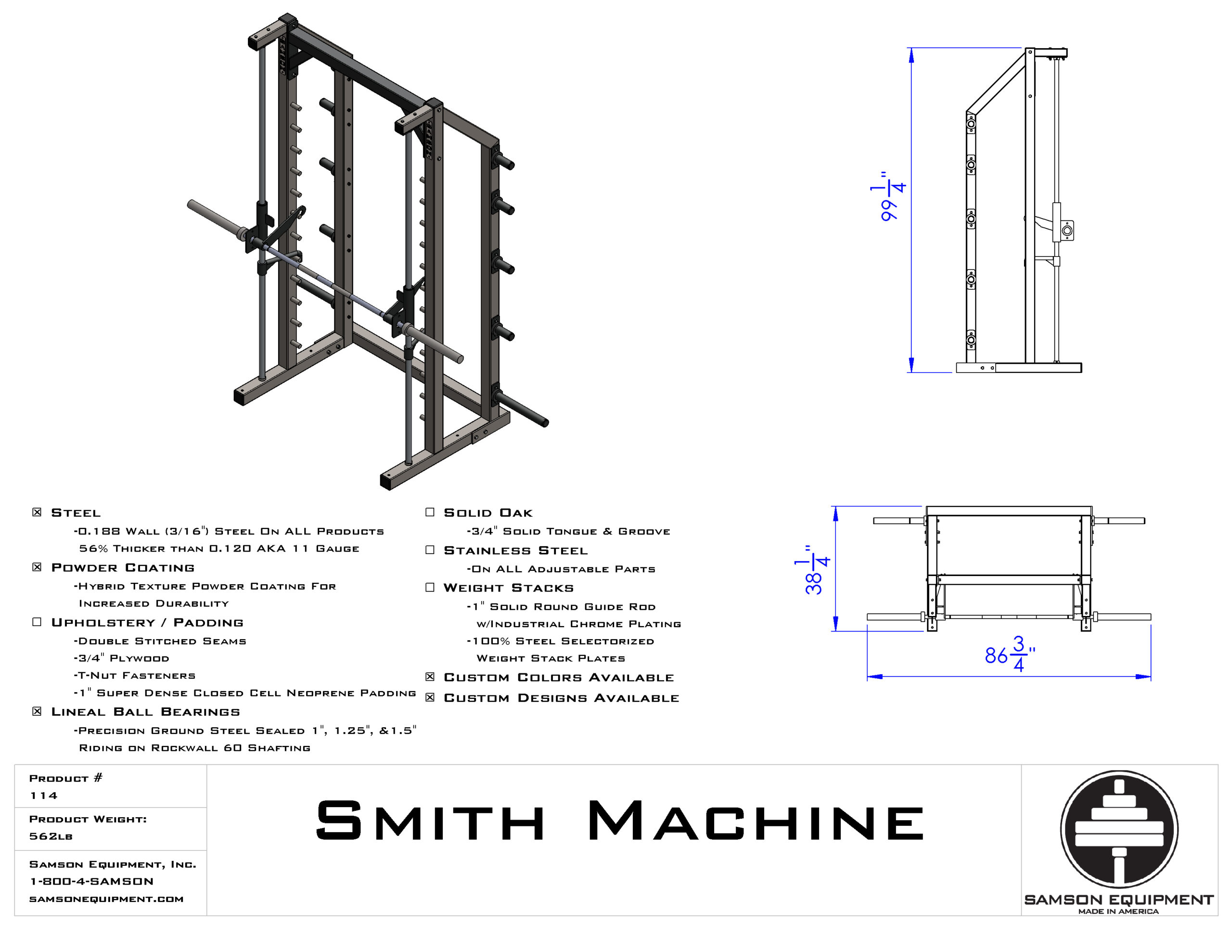
Product Specifications
| Dimensions | N/A |
|---|
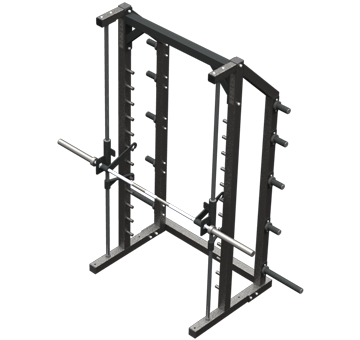
Smith Machine: A Versatile Station for Structured Training
In an institutional weight room, equipment isn’t just about exercise variety—it’s about throughput, safety, and consistency across many athletes with different experience levels. A smith machine provides a guided bar path that can support structured strength training, supplemental work, and safer progressions when athletes are learning movement patterns or training without a dedicated spotter.
When planned correctly, a smith machine becomes a high-value station in a machine lane: it supports multiple exercise variations, fits well into circuit-based training, and helps coaches manage risk while still driving intensity.
Why schools and teams add a smith machine
Free weights are foundational, but machine stations can be strategic additions—especially when group sizes are large or coaching resources are limited. A smith machine is often selected because it can serve many different training goals in one footprint.
- Guided bar path: supports consistent rep quality, especially for newer athletes.
- Versatility: enables multiple movement variations from one station.
- Throughput: functions well in lanes and rotations.
- Programming flexibility: useful for both strength work and supplemental volume.
Common uses in a strength and conditioning program
Coaches use smith machines in different ways depending on team needs, training phase, and space constraints. The main advantage is structure: athletes can execute movements with a consistent setup, which helps keep sessions efficient.
Typical programming applications
- Supplemental strength: add volume after primary free-weight lifts without extending session time.
- In-season training: maintain strength and patterning with controlled fatigue.
- Teaching progressions: support athletes learning squat and pressing patterns with a stable setup.
- Accessory lane work: build a machine lane that keeps groups moving during rotations.
- Team training efficiency: reduce bottlenecks when racks are heavily occupied.
Exercise variety (one station, many options)
One reason facilities choose a smith machine is the versatility: one station can support multiple patterns depending on how you program and coach the movement. The exact selection is up to the coaching staff, but common categories include:
- Pressing variations: supplemental volume when bench stations are busy.
- Squat-pattern variations: controlled sets that emphasize consistent mechanics.
- Accessory patterns: movements that build extra volume without taking a primary rack.
- Tempo and control work: reps coached for technique development and consistency.
How to place a smith machine in your facility layout
A smith machine is most effective when it’s placed in a zone designed for machines and accessory stations, rather than in the middle of a rack lane. This keeps traffic organized and preserves clear movement space for free-weight training.
When planning placement, consider:
- Coaching visibility: keep machine lanes visible so staff can cue and supervise.
- Clearances: ensure athletes have room to load plates and move safely around the station.
- Adjacency: place near complementary stations (benches, dumbbells, accessory equipment) to reduce crossing traffic.
- Flow: avoid placing it in the most congested path between racks and storage.
If you want help mapping out a complete plan that balances racks, free weights, and machines, start here: Start Your Free 3D Layout Design.
When a smith machine is especially useful
Every room is different, but certain constraints make a smith machine particularly valuable:
- Large group sizes: you need more stations to maintain training density.
- Limited coaching staff: guided stations can help standardize setups while coaches prioritize the highest-risk lifts.
- Busy rack lines: a machine lane can relieve pressure on primary rack stations.
- Mixed experience levels: a consistent station can support athletes progressing into heavier work.
Throughput check (a practical question to ask)
If you routinely run sessions where athletes are waiting on racks or benches, adding a versatile station can increase training density without expanding the room. The best approach is to plan machine lanes and rack lanes together so stations complement each other instead of competing for the same traffic space.
Balancing machines and free weights
Great rooms don’t “replace” free weights with machines—they use machines to support programming, flow, and capacity. A typical institutional room includes:
- Primary strength zone: racks/rigs and platforms for main lifts.
- Free weight zone: dumbbells, benches, and open space for accessory work.
- Machine lane: targeted stations that support higher throughput and consistent execution.
- Accessory + durability zone: smaller footprint pieces that help athletes build resilience.
Explore other machine options to build a balanced lane: Machines.
Ordering guidance and project support
Samson projects are often planned around the full facility—equipment, layout, athlete flow, and long-term durability. If you’re selecting machines for a new build or renovation, it’s worth evaluating how the machine lane integrates with racks, storage, and coaching sightlines.
For pricing, configuration support, and help building the right equipment mix, reach out here: Contact Samson Equipment.
Tip: plan the machine lane as a “rotation lane”
If your training model uses stations, designing the machine lane as a clear rotation path improves flow. Identify which movements belong in the lane, how many athletes will cycle through it at peak times, and where storage and walkways need to stay open.
FAQs: Smith machines in institutional facilities
Is a smith machine appropriate for athletes?
Yes, when used intentionally. Many programs use it as supplemental work or as a tool for structured progressions. Coaches decide how it fits within their overall philosophy.
Will it replace racks?
No. Racks and rigs remain the backbone of most programs. A smith machine is typically an addition that improves throughput and programming flexibility.
Can Samson help me decide what to buy for my space?
Yes. The right equipment mix depends on room size, group size, and how you coach. A layout-first approach reduces mistakes and helps the room run better from day one.
Request Pricing and Layout Support
Want a machine lane that supports high-volume team training? Add versatile stations like a smith machine and plan placement for flow and safety. For help designing your space and selecting the right equipment, contact Samson.
Ordering, support, and facility planning
In a high-volume facility, the right equipment is only part of the solution. Planning station counts, storage, and traffic flow helps teams train efficiently and keeps equipment in better condition long-term. If you’re building a new room or upgrading an existing space, Samson can help you choose the right mix of stations and accessories so the room works under real training volume.
For help selecting options, confirming fit, and building a complete equipment list, reach out here: Contact Samson Equipment. If you’re planning a full room layout, you can also start a free design conversation here: Start Your Free 3D Layout Design.
Quick FAQ
- Who is Samson equipment built for? Samson serves institutional facilities such as schools, colleges, teams, municipalities, and tactical organizations.
- What is the typical manufacturing lead time? Orders typically take about 10 weeks to manufacture, depending on design complexity.
- Does Samson provide layout and 3-D design support? Yes, Samson uses two- and three-dimensional layouts to help plan station counts and room flow.